










Welcome from the Chairs of NoF 2026
On behalf of the Network of the Future (NoF) Organizing Committee, we are pleased to welcome you to the 17th International Conference on Network of the Future (NoF 2026), taking place in Rome, Italy, from September 29 to October 2, 2026.
Rome, the Eternal City, provides a memorable setting for NoF 2026, combining history, beauty, and atmosphere. Built on seven hills and crossed by the Tiber River, it offers millennia of art and architecture, from the Colosseum and the Pantheon to Piazza Navona and the Trevi Fountain. Its domes, bridges, and green spaces, including Villa Borghese and Appia Antica Park, make the city both timeless and vibrant.
NoF 2026 aims to bring together the community to discuss and shape the evolution of networking. Since its creation in 2010, NoF has established itself as a premier annual conference on Future Internet design, focusing on enabling technologies, architectures, and services.
In recent years, communication infrastructures have undergone a profound transformation, increasingly combining connectivity, computation, and control. Cloud-native design, intent-based and autonomous operation, and artificial intelligence (AI)-driven orchestration are making them more resilient, sustainable, and user-centric. Advances in generative and agentic AI, data-driven methods, and network foundation models are also raising automation levels, enabling more proactive operation and opening new paths toward fully autonomous systems. As these infrastructures expand their role, security, trust, and privacy become even more central, from safeguarding the physical world inferred through integrated sensing to defending software- and AI-driven environments. Digital twins, zero-touch automation, semantic communications, and multi-path and multi-domain integration are redefining how connectivity supports humans and machines. At the same time, momentum behind sixth-generation mobile communication systems (6G) continues to grow, with visions of integrated terrestrial and non-terrestrial systems, immersive experiences, and new requirements for trust and sustainability shaping the future Internet.
NoF 2026 opens on September 29 with a full day of tutorials and workshops. The tutorials address Software-Defined Wide Area Networking (SD-WAN) for edge network automation and decision intelligence, and reinforcement learning for next-generation Industrial Internet of Things (IoT) networks. The conference also features two workshops: Experimental Research on Networking (ERN) and From Meaning to Intent: Semantic Communications and Intent-Based Networking (SICN) 2026.
Over the following three days, the conference includes 8 technical sessions, a demo session, 3 keynotes, and a panel.
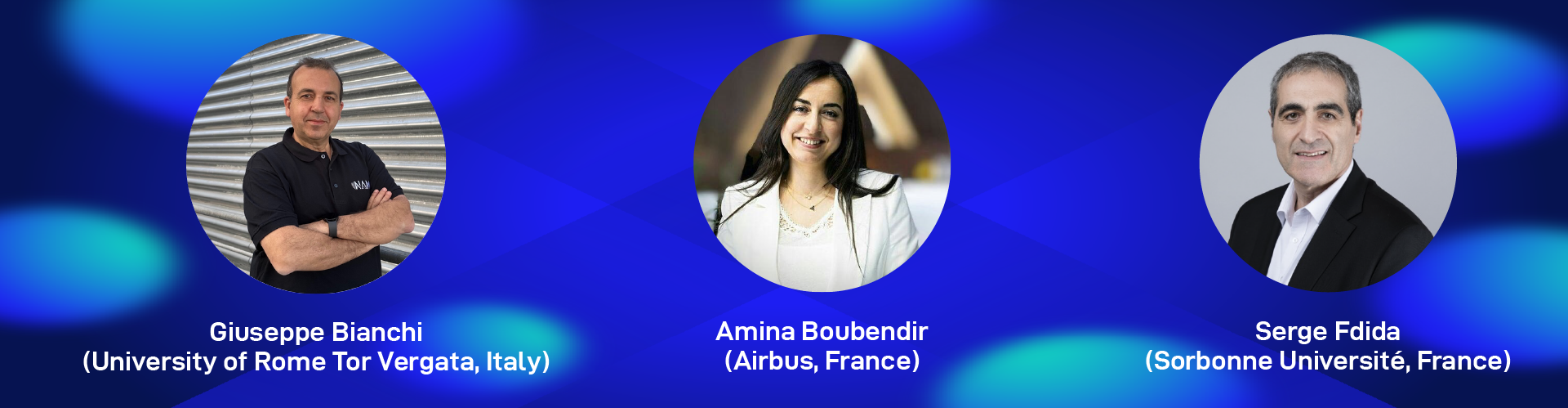
Giuseppe Bianchi (University of Rome Tor Vergata, Italy) will open the keynote series by exploring what happens when wireless signals not only carry data but also sense the physical world. Focusing on Integrated Sensing and Communication (ISAC), he examines emerging privacy and security risks in fifth-generation mobile communication systems (5G) and beyond, including attacks that manipulate sensing signals to inject, move, or conceal objects in the perceived environment.
Amina Boubendir (Airbus Defense and Space, France) will address the convergence of terrestrial and non-terrestrial networks in 6G, with Direct-to-Device connectivity as a key outcome. Her keynote covers multi-orbit and multi-provider service aggregation, cross-technology interoperability, network softwarization for multi-provider orchestration, and progress in standardization.
Serge Fdida (Sorbonne Université, France) will present SLICES-RI (Scientific Large-scale Infrastructure for Computing/Communication Experimental Studies Research Infrastructure), the first large-scale scientific instrument for the digital sciences on the European Strategy Forum on Research Infrastructures (ESFRI) roadmap. His talk discusses its beyond-5G and 6G blueprint as a platform for reproducible experimentation and for building network foundation models, supported by agentic AI and machine learning operations (MLOps).
The schedule also features a panel, “Networks in the AI Era: Data as a Goldmine for Research and Innovation,” moderated by Guillaume Doyen (IMT Atlantique, France), bringing together a diverse set of experts: Jovanka Adzic (University of Belgrade, Serbia), Kohei Shiomoto (Tokyo City University, Japan), Gregory Blanc (Télécom SudParis, Institut Polytechnique de Paris, France), Marco Forzati (Swedish Innovation Agency, VINNOVA, Sweden), and Andrea Petroni (Fondazione Ugo Bordoni, FUB, Italy).
We thank all members of the technical and organizing committees, as well as the reviewers, authors, and presenters, whose contributions have shaped NoF 2026.
Beyond the technical sessions, we invite you to enjoy the social events: a welcome reception on the Roof Garden of the Hotel Forum, and a guided tour of Trastevere followed by the conference dinner at Ai Bozzi Restaurant, in the heart of Trastevere, featuring contemporary cuisine rooted in Roman tradition. These occasions will offer a chance to experience Rome’s atmosphere and flavors in good company.
We look forward to seeing you in Rome for an inspiring and engaging NoF 2026.
General Chairs

Barbara Martini
(Universitas Mercatorum, Italy)

Paolo Monti
(Chalmers University of Technology, Sweden)
TPC Co-Chairs

Sahar Hoteit
(Université Paris-Saclay, France )
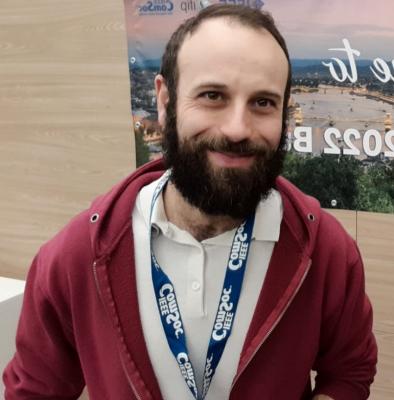
Marco Polverini
(Università La Sapienza, Italy)
Sahar Hoteit
(Université Paris-Saclay, France )
Marco Polverini
(Università La Sapienza, Italy)